
ABOUT
US
Dr.
Debraj Shome
Awards
& Recognition
|
 |
I)
Dr.
Debraj
Shome awarded extremely prestigious Colonel Rangachari Gold Medal Award
and
Hanumantha Reddy Award for 2010
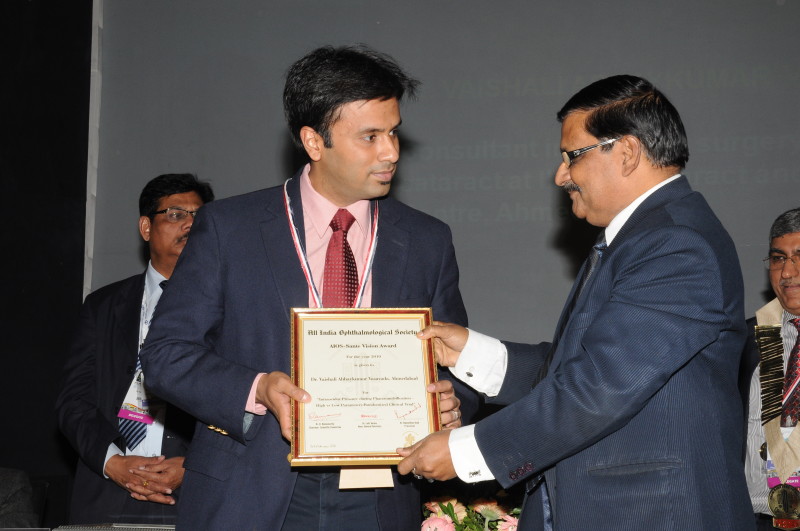
Dr.
Debraj
Shome has been awarded the extremely prestigious Colonel Rangachari
Gold Medal
Award and the extremely prestigious Hanumantha Reddy Award for the year
2010 at
the Annual Conference of the All India Ophthalmological Society meeting
held at
Kolkata in January.
The
Colonel
Rangachary Gold medal Award is awarded for the best research conducted
in India
during the previous calendar year and is awarded to Best Paper read at
the
Special Plenary Session of the annual conference of India’s national
ophthalmological society. This award can be won by an individual only
once in a
lifetime. Dr. Debraj Shome is the youngest ever recipient of this
extremely
prestigious award and this award bears testimony to the exceptional
work being
performed by Dr. Debraj Shome.
The
Hanumantha Reddy Award is awarded for the Best Paper presented at the
annual
conference of the Society in the Pediatric Ophthalmology (Child eye
diseases).
This award is given only once in two years and is
awarded for the best
research conducted in India during the previous calendar year in
Children’s
diseases and is awarded to Best Paper read at the Special Plenary
Session of
the annual conference of India’s national ophthalmological society.
These
awards
were presented to Dr. Debraj Shome for presenting the revolutionary
paper
"NON ALBUMIN CONTAINING NANO MOLECULE OF CARBOPLATIN IN AN
ADJUNCTIVE
ROLE IN RETINOBLASTOMA".
Retinoblastoma
(RB) is the commonest primary eye cancer in childhood with an incidence
of 1 in
20000 live births. Most of the patients are younger than 2 years and
rarely
tumors presenting at birth with systemic metastasis (tumor spread) have
also
been described. RB may be multifocal or unifocal and involvement is
usually
asymmetrical in bilateral cases. Patients with bilateral retinoblastoma
have
historically been treated with eye removal. Dr. Shome’s research
conducted
leading a multi-centric trial of the best possible talent in India
promises to
shift paradigms in the treatment of this child-killer.
Clinical
trials have demonstrated the efficacy of intra-venous carboplatin
therapy in
the management of multiple pediatric cancers (neuroblastoma, Ewing
sarcoma,
Wills tumor) and adult cancers as well. For these reasons, carboplatin
is
included in treating many cancers. Systemic chemotherapy coupled with
appropriate focal therapy has become the current standard of care in
the
management of most neural and eye tumors. However, systemic
chemotherapy is
associated with its own risks. The regimens currently used can cause
transient
neutropenia, anemia and thrombocytopenia that may require blood product
transfusions, and organ toxicities including ear toxicity, kidney
toxicity, and
liver toxicity. This is especially true in children as many children
even die
not from the cancers per se but from the drugs injected.
In
a
landmark series of experiments, an Indian group led by Dr. Debraj Shome
has
come closer to treating neural and eye cancers better. The first step
occurred
when Dr. Santosh Honavar of the L V Prasad Eye Institute, Hyderabad and
Dr.
Debraj Shome of the Tata Memorial Center Mumbai started using
carboplatic
injections locally instead of intra-venously (thru the blood) to treat
children
with eye cancers. The rationale for using local (around the eye)
carboplatin
injections was to increase the concentration of the drug within the eye
without
incurring additional systemic toxicity from increasing intra-venous
dosages.
This was extremely successful and more than 60% of the children treated
benefitted from this regimen.
Said,
Dr.
Debraj Shome, Consultant Facial Plastic Surgeon and eye cancer expert,
Apollo
Hospitals, Hyderabad, “After the success of the first trial, we
hypothesized
that reducing the size of the drug molecule may further increase
concentration
in the body. Hence, our group created a novel nanomolecule carboplatin
for the
local injections. We found as much as 11 times greater penetration into
the
body with this newer drug as compared to the carboplatin drug available
in the
market. This was a huge breakthrough.” This new molecule was created in
collaboration with Dr. Jayesh Bellare of IIT, Powai. This was the first
time
ever in the world that carboplatin had been made available in a nano
form. This
revolutionary research was subsequently lauded by medical experts
worldwide and
was published in the Investigative Ophthalmology and
Visual Sciences,
possibly the best eye research journal.
However,
the
group kept striving to push the barriers of science further. Said Dr.
Shome
“This trial proved that the new molecule created by us has greater
penetration
(due to a smaller size and greater osmotic diffusion gradient) in to
the
body. While this would revolutionize therapy of cancers in
the world, we
were still not happy as this particular nanomolecule contained a
protein.”
While the insertion of the protein (albumin) was essential for
developing the
molecule, there was a very small theoretical chance (less than 0.1%) of
the
protein causing allergic reactions in the brain and the eyes of the
recipient.
So, the risk was that patients treated with this drug could have some
form of
allergic reactions in the brain and so a non-protein based nanomolecule
was
best. Said Dr. Shome, “The problem however for our group was that a
nanomolecule
without a protein base had never been produced anywhere in the world,
not only
for carboplatin, but also for any chemotherapy ever targeted against
the brain
and the eye cancers.” The group kept working on the process and finally
have
developed a PMMA based nanomolecule of carboplatin. Said Dr. Debraj
Shome,
“Poly methyl methacrylate (PMMA) is a bio-neutral substance and is used
commonly for lenses used post cataract surgery. It has a long history
of
complete safety.” This is the first time that PMMA has ever used been
used in
developing this revolutionary new nano-molecule of carboplatin which is
now
being used in trials in cancer patients.
Dr.
Debraj
Shome, who leads this group, has been recently awarded the extremely
prestigious Hanumantha Reddy award (the highest award for research in
children’s cancers) and the Colonel Rangachary Gold Medal (the highest
award
for research conducted this year) for this revolutionary research at
the annual
conference of the annual meeting of the All India Ophthalmological
Society,
held at Kolkata in January 2010. Said Dr. Shome, “This multi-centric
trial once
again proves the excellence of Indian doctors and scientists. This drug
will be
of immense use in treating not just eye cancers but also brain cancers
and
other pediatric cancers” This revolutionary research is clearly India’s
gift to
the world.
Phase
I:
Injecting chemotherpeutic drugs locally in eye cancers (2005 – 2006)
Phase
II:
Developing a nano-molecule of carboplatin (a chemotherapy drug). (2007)
First
ever carboplatin molecule so altered in the world, for
greater penetration into tissues.
Research
published in top international research journal.
Phase
III:
Developing another nano-molecule of carboplatin. More advanced than
Phase II as
this molecule does not have any protein and is carried by PMMA, a
completely
bio-inert and safe substance to the human body. (2009)
First
time ever any chemotherapy drug used against brain and eye
cancers has ever been produced without proteins anywhere in the world.
Dr.
Debraj Shome awarded the Hanumantha Reddy and the
Colonel Rangachary Gold Medal Awards (2010).
Phase
IV (in
the future):
Create newer drug delivery mechanisms to introduce the drug inside the
organs
such as the eye and the brain.
__________________________________________________
II)
Dr.
Debraj Shome awarded
extremely prestigious Davies Foundation Grant Award by the Royal
College of
Surgeons, Glasgow
Dr.
Debraj
Shome has been awarded the extremely prestigious Davies Foundation
Grant Award
by the Royal College of Surgeons, Glasgow, United Kingdom in 2010. This
Grant
Award is awarded to only two outstanding physicians from over
the globe
who have performed sterling work in cancer research and therapy, have
contributed to life-saving research and have changed the entire
paradigm of
cancer therapy in the world.
This
Grant
Award established through the William and Elizabeth Davies Charitable
Foundation is made exclusively available by the Royal College to its
Fellows
and Members. The William and Elizabeth Davies Charitable Foundation
awards an
extremely prestigious Grant Award to The William and Elizabeth Davies
Foundation supports a range of activities geared towards improving the
management of cancer. The Davies Foundation Travelling Fellowship
offers two
awards of £10,000 towards a wide range of activities to support
research,
education and training in cancer care and treatment.
These
include:
Fellowships,
to allow young doctors to develop a career in
research;
Provision
of training in the diagnosis and treatment of cancer;
Named
international lectures on all aspects of cancer
management;
Visiting
Professorships to enable outstanding practitioners and
scholars to contribute to cancer education and research in the West of
Scotland; and
Facilities
to support the development of diagnostic and
therapeutic skills.
Dr.
Debraj
Shome is the youngest ever recipient of this Award world-over.